Golden sunlight filtered through the city’s skyscrapers, turning the old cathedral’s stone from a pale gray to an inviting gold. The Right Reverend Thomas Paul locked the red wooden front doors for the night. Normally, the sexton would have locked up, but Reverend Paul did tonight. If he had been Presbyterian, he would have said that what was to follow was predestined. Whatever it was, it was definitely a Godsend.
The cathedral was an architectural marvel. Built by craftsmen during the Gilded Age, it was financed by men who realized, at an advanced age, that they needed more umpth to their heavenly resumes. Reverend Paul’s favorite feature was the Tiffany glass image of Jesus turning water into wine. The next morning, Paul looked up at the magnificent glass. Colored light from the rising sun illuminated him as he worried about the church’s future. Scandal, changing times, and an aging congregation had caused the pews — and coffers — to grow increasingly empty. He looked up and said under his breath, “Jesus help me. No, help this church.” As he walked out of the nave and into the hallway that led to the church offices, portraits of stern-looking men glared at him. “They had it easy,” he thought. “All they had to do was unlock the door on Sunday to fill this place.” During the morning Vestry meeting, Paul and his Vestry strategized about how to save the cathedral. They had tried every gimmick in the book to attract younger parishoners. “What about a rock band?” one vestry member proposed. That would have killed off the rest of the older parishioners in one fell swoop. “They had better play Stairway to Heaven — because it’s going to be needed when Mrs. Smithmore (the 80-year-old heir to the BowWow pet food fortune and the cathedral’s biggest donor) drops dead.”
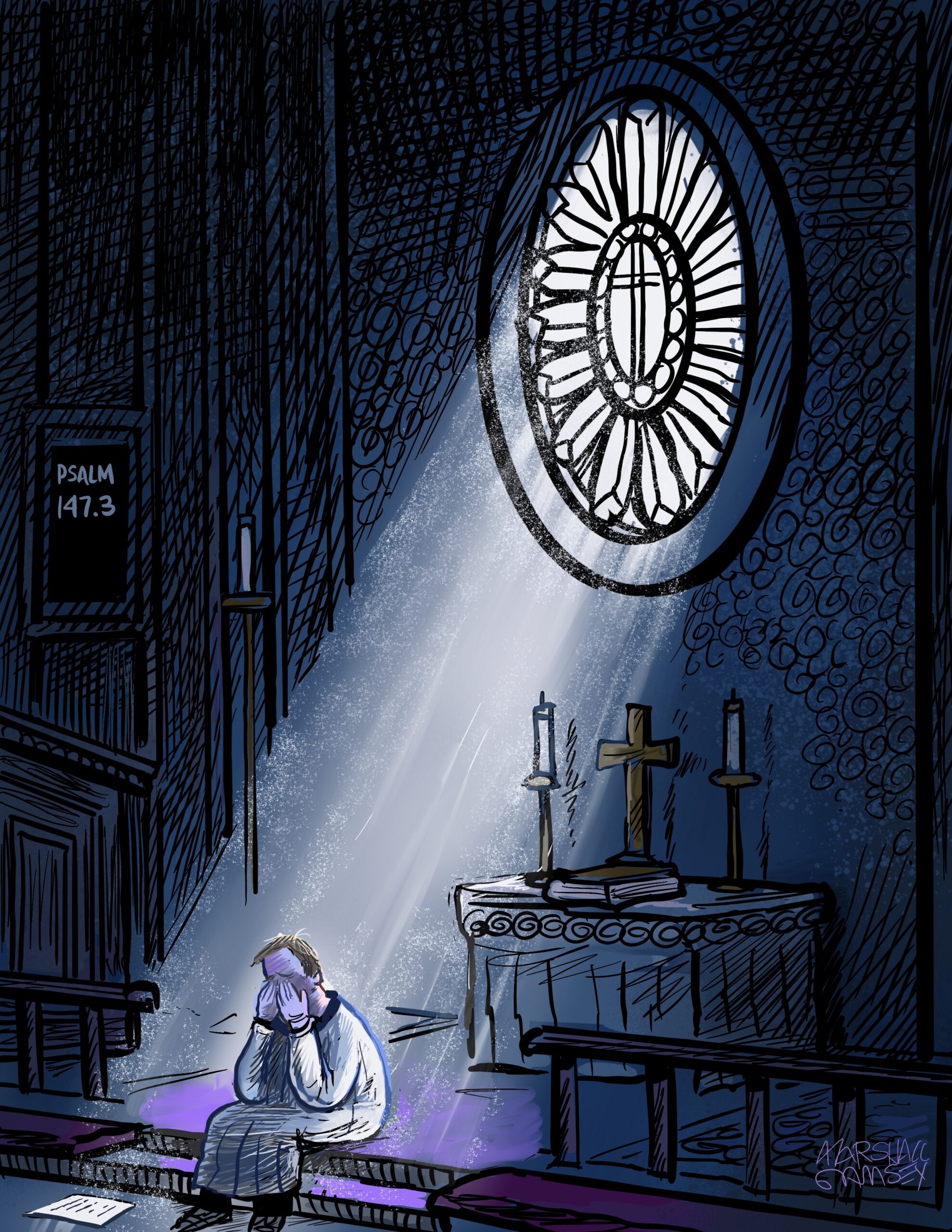
Sunday’s service was a quarter full. The plate was even emptier. Paul gave his homily and watched the remaining members shuffle out of the old church. He went back to his office, got his overcoat and hat, and swallowed his pride. An ambitious attorney in his former life, the good Reverend Paul wasn’t used to losing. He tasted acid in his throat. So this was what it was like? He sat beneath the Tiffany Jesus and cried.
After he gathered himself, the priest walked outside and locked the front door; he then heard a sound. “Psst.” It was one of the many homeless who lived downtown. Some said this was why no one wanted to come downtown. Reverend Paul jumped initially, then caught himself and felt ashamed of his fear.
“I’m sorry. May I help you?”
The homeless man, who looked to be in his 30s with a deep tan complexion and burning brown eyes, looked into Paul’s eyes and said, “No. But I can help you.”
Reverend Paul instantly slipped into priest mode, shrugged off the comment, and said, “Let me buy you lunch.” The two men walked to the nearby diner, where they broke bread together.
Tuesday at lunch, the Reverend Paul, intrigued by his new acquaintance, went looking for him. There, in the alley next to the cathedral, was a small encampment: a tent with a sleeping bag, a couple of books, a small lantern, and some empty cans tucked in behind an old fence. The priest had never seen this before, and he vowed to become more aware of the neighborhood surrounding his church.
“Hello there,” a familiar voice rang out. The priest turned around to see the man.
“I found you,” the priest said.
“But seek first the kingdom of God and his righteousness, and all these things will be added to you.”
“That’s pretty good,” the priest said. “You have read the Bible?”
“How about lunch?” the man replied.
“Lunch is good.”
As they ate, the man pulled a crumpled piece of paper from his shirt. “I’d like you to read this,” he said. Being polite, the priest took the paper, put on his readers, and began to take in what the man had written.
“This is really, really good,” the priest said.
“Thanks.”
The following Sunday, he committed what would be a sin in the journalism world: he plagiarized. He took out the crumpled paper and read it verbatim, feeling both relief and guilt as the words carried him. Light glowed through the Tiffany Jesus and onto the congregation.
The next Tuesday, the priest and the man had lunch again. Once again, the priest took the man’s writings and passed them off as his own. Once again, the glow illuminated a now larger congregation. Paul told himself he would stop soon, but the promise felt weaker each time.
This went on for a year. The man got a lunch, and the priest got a full church. Soon, the cathedral was full. A second service was added. The man collected the sermons and put them out as a book. TV stations had him on to share his wisdom. The light coming from the stained glass burned brighter and brighter. Paul should have felt triumphant, but instead he felt increasingly cornered by what he owed.
On Epiphany, the priest began his sermon to another packed crowd. There, in the back of the church, was the homeless man. The priest saw his deep brown eyes and felt a burning in his heart. The glow from the window stopped for a moment and then burned brighter. Before the closing prayer, the homeless man walked out. The priest didn’t greet the flock — instead, he ran out after the man who had rebuilt the cathedral. Reverend Paul felt a deep shame as he caught up to his now-friend and said,
“I stole from you. I am SO SORRY,
“I know how you can repay me. Get me a bottle of water.”
Stunned by the request, the priest ran back into the cathedral and to the breakroom fridge.
Panting, he handed the bottle to the man.
“Remember when I told you I’d save you?”
The priest thought for a moment as the man continued.
“You showed me kindness when no one else would. Blessed are the merciful, for they will receive mercy.”
That’s when the man took a sip of water and set the bottle down. “Don’t be so doubting, Thomas. It’s not a good look on you.” The Reverend Thomas Paul looked into the man’s eyes and witnessed his whole life flicker past. From the pain as a child, to the fear as an adult. It all washed away.
“I love you, Thomas. And that’s what it is all about. So release your fear,” the man said, then turned to leave. He walked down the street until he disappeared out of sight.
Stunned and with tears in his eyes, the priest turned to pick up the bottle of water. As he looked down at it, he understood the gift he had been given.
It was wine.